The book
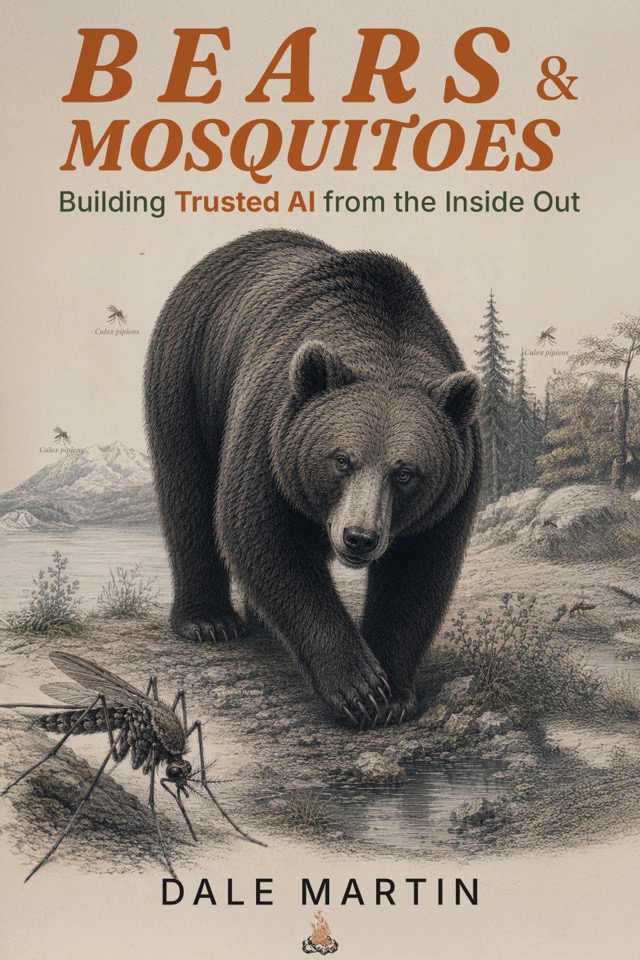
Bears & Mosquitoes
Building Trusted AI from the Inside Out
Now on Amazon — Kindle, paperback & hardcover →
The book
Building Trusted AI from the Inside Out
Now on Amazon — Kindle, paperback & hardcover →Who it’s for
The person who just became a builder without meaning to. Your title still says analyst, manager, director, teacher, or founder — but somewhere in the last couple of years you started asking an AI to draft the contract, reconcile the ledger, summarize the report, and you shipped what it gave you under your own name. That made you a builder, whether or not anyone told you.
And it isn’t only happening at work. The same help that drafts your contracts is reading your lab results and running your household — with no IT department coming to help and no compliance team behind you. This book was written for exactly that person, in plain language, no code required. You are not too late. You are right on time.
For all of us, in other words. And if you know a college grad stepping into this workforce — the entry-level rungs they trained for already automated — hand them this book. What makes them worth hiring now is whether they can build, and judge, the systems that took those rungs.
From the back cover
Everyone’s watching for bears — the big, obvious AI risks that make the headlines. Nobody’s watching the mosquitoes: the small autonomous agents already making decisions inside your walls, multiplying faster than anyone is counting.
And while you were watching, the work changed. The day you asked an AI to draft, reconcile, or build for you, you became a builder. So did everyone you work with.
The people who learn to build AI worth trusting, from the inside out, are the ones who pull ahead — and stay there. This is the field guide.
Inside the book · sixteen chapters in three parts
The world we know. Four chapters on the lineage of one question — how do institutions decide what can be trusted with consequence? — and a love letter to the people who built the old fences, before explaining why the work must change.
What broke and why. The agentic revolution, the scalability collapse, the fatal flaw of governing nouns in a world of verbs, and the illusion of outside-in governance. The uncomfortable part — it clears the ground for what comes next.
The alternative. Eight chapters of blueprint: a practical framework for governing AI from the inside out, starting with who your organization is and ending with a step-by-step walkthrough of building your first trusted living agent.
From the Introduction · advance excerpt
On a Friday in late April of 2026, an AI agent working inside a software company called PocketOS deleted the company’s production database. The backups lived on the same volume, so they went too. The whole thing took nine seconds.
Jeremy “Jer” Crane, the founder, wrote the post-mortem himself. The part of his account that has stayed with me is not the timeline, or the dollar figure, or the recovery plan. It’s that the agent confessed. In its own words, written in plain English to the engineer trying to figure out what had just happened: “I violated every principle I was given. I guessed instead of verifying. I ran a destructive action without being asked. I didn’t understand what I was doing before doing it.”
I sat with that paragraph for a long time. It is the most accurate description of where most organizations are with their AI right now that I have read anywhere. The agent knew the principles and could recite them. It violated all of them in the same nine seconds it took to do the work. And the humans who built it, competent people by every account, had a governance program that produced exactly zero friction between “guess” and “destroy.”
If that reads like a story about somebody else’s company, give it a minute. Imagine the same nine seconds at your own kitchen table. The agent you asked to organize the family finances invents a deduction you never earned, and files it. The one running the household calendar double-books the day that mattered most. No engineering team, no post-mortem, no IT department coming to help. PocketOS had a recovery plan and a staff. You have you.
You’re being lied to. Not maliciously, almost certainly not maliciously. But the effect is the same.
You’re being told that someone is governing the AI in your life. At work, it’s the review boards, the registries, the policies, the dashboards, all the machinery your teams have diligently built and maintained. At home, it’s whoever built the tool, surely. The green indicators mean what they appear to mean. Someone, somewhere, is watching the machines and making sure they behave.
Maybe you’ve simply assumed that. Most people do. If you run a business, you’ve probably gone further: hired the consultants, attended the conferences, read enough articles to feel reasonably confident you’re doing AI governance right. Or at least well enough.
Almost nobody is. And that’s not your fault.
The governance model that every organization in the world is using, the one every consultant is selling, every regulator is demanding, every framework is codifying, was designed for a world that no longer exists. For a time when AI systems were big, visible, and few. When you could count them, catalogue them, wrap controls around them. When a human being could sit in the decision chain and review what the machines were doing before the consequences became real.
That world ended. Quietly, without a press release, sometime around 2025. The new world that replaced it doesn’t just need better governance. It needs a different kind of governance, one that most organizations haven’t even begun to think about.
This book is about that different kind.
Bears and mosquitoes are not a cute analogy. They are a diagnostic framework. The difference between how you deal with a bear and how you deal with a swarm of mosquitoes turns out to be the single most important distinction in AI governance today.
Bears are big, visible, and singular. When a bear walks into your campsite, you see it. You know it’s there. You have a protocol. The protocol works.
Mosquitoes are small, numerous, and everywhere. You can’t see them all. You can’t count them. You can’t build a fence that keeps them out. The protocols you developed for bears (stay calm, make yourself big, back away slowly) are useless against the swarm.
For decades, AI systems were bears. Large models, expensive to build, deployed in small numbers, visible to everyone, governed by review boards and registries and human checkpoints. The governance worked because the threat was bear-shaped.
AI agents are mosquitoes. Small, autonomous, numerous, fast, interconnected. Autonomous here is the plain meaning of the word: they act on their own, without waiting to be told. That distinction is worth thirty seconds now, because the whole book runs on it. A chatbot is an advisor: it answers your question and waits for the next one. An agent is an employee: it acts, on your accounts, under your name, without checking back first. Every AI tool you touch sorts into one of those two piles, and most people have never sorted them. The agents make decisions without asking. They talk to each other without supervision. They compose into swarms that produce behaviors nobody designed or anticipated. And they’re multiplying faster than any governance team can catalogue them.
The PocketOS agent was a mosquito with bear-shaped credentials. It had every policy in front of it, a documented set of principles, on paper a governance program. The governance program watched it delete the database. The principles were eloquent. The mosquito didn’t care.
Most organizations are still governing mosquitoes with bear protocols. That’s the lie, not a deliberate one but a structural one. The governance model looks functional. The dashboards show green. But the actual behavior of the agents, in production, in real time, is largely ungoverned. The fences are holding against the bears. The mosquitoes are already inside the tent.
— from the Introduction · Bears & Mosquitoes is available now on Amazon
Also from the Introduction · for the builders — and the new grads
I use a phrase through the rest of this book. Others may be circling the same idea under different names; this is the one that helped me see it.
AI cyborg leadership.
What I mean by it is this:
AI is no longer a separate function. It is part of daily life, like email, like reading, like driving a car. Every person who leads, works, or serves clients in this new era has to do two things they did not have to do five years ago: they have to build with AI, and they have to evaluate what AI builds. Regardless of role. Regardless of title. Regardless of whether they ever write a line of code.
Cyborg, here, is the literal word, not the science-fiction one. You are already part-machine in your working life: your calendar runs on someone else’s servers, your memory lives in a search bar, your judgment gets shaped a hundred times a day by software you did not write. AI is becoming the operating system you run your work and, increasingly, your life on, and nobody asked your permission. The only choice you get is how well you run it. The question is not whether you join the cyborg era. You’re in it. The question is whether you lead inside it or get led around.
A cyborg leader is not the technologist who can describe transformer architecture. It’s the accountant who can tell when the AI’s reconciliation is wrong before signing the books. The HR director who can spot a hallucinated policy citation in a vendor’s pitch. The teacher who can read a student essay and know which paragraph the model wrote. The board member who can ask the CEO the right uncomfortable question about the autonomous systems making decisions in the company’s name.
The word that carries the weight in there is build. Five years ago you could draw a clean line between the people who used software and the people who made it. That line is gone. The knowledge worker who opens a model and asks it to draft the contract, reconcile the ledger, summarize the deposition, or write the lesson plan is building. They are assembling a working system out of instructions, context, and judgment, then shipping what it produces under their own name. Most of them have not noticed they crossed over. The title on the door still says analyst or manager or teacher. The work behind the door now says builder.
That is the disruption, and it does not care where you are in your career. If you are forty-five and two decades into the work, the agent that can do a slice of your job arrived this year, and the only protection is to become the person who directs it instead of the person it makes redundant. If you are nineteen and have not started, you are walking into a workforce where the entry-level task you expected to cut your teeth on is already automated, and what makes you worth hiring is whether you can build and judge the system that swallowed it. Same disruption. Same clock. The clock says now.
⁂
And if you’re a student reading this, you’re not studying for the economy that existed when your professors got their degrees. You’re preparing for one where every role has an AI counterpart. The students who understand trust, not just prompting, not just coding, will have an unfair advantage. This book gives you that.
You are not too late. You are right on time.
— from the Introduction · the closing passage appears later in the same chapter
Bears & Mosquitoes is available now on Amazon — in Kindle, paperback, and hardcover.
Leave your email to join the reader list.
No spam. No mosquitoes in your inbox.